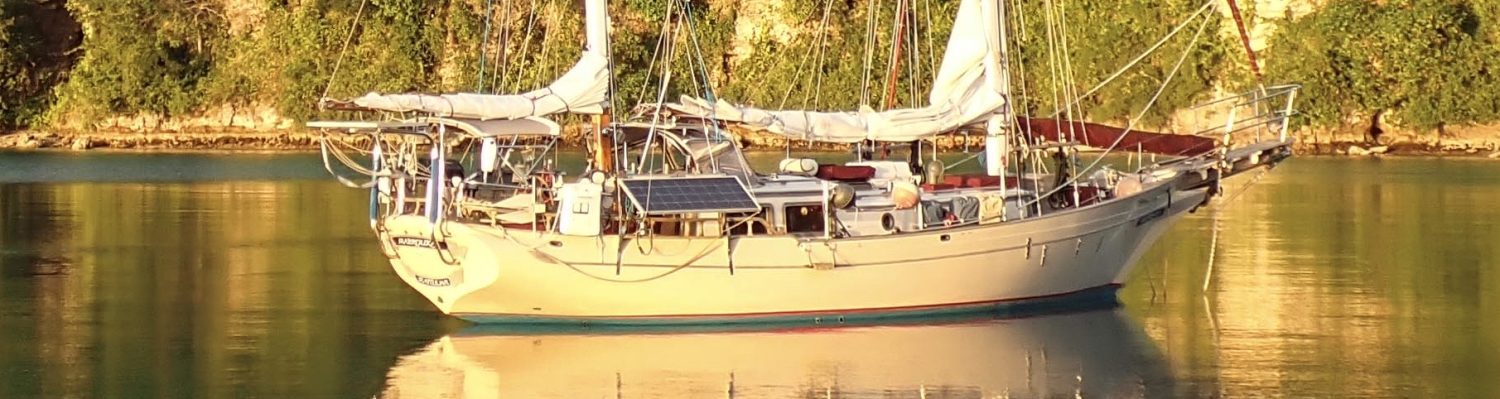
This post has been on my mind for quite some time. Years, perhaps, but it has hopefully risen to the level of lessons learned more than simply a frustration dump. The story starts with expressing the romantic inspirations that my first meeting with Mabrouka evoked. I do occasionally object to modern yacht styles, from stark plumb bows to taffy-swoop salon windows. There’s no doubt that a gently curving shear line bookmarked between the graceful arc of a clipper bow and the reverse angle of a wineglass stern that form the familiar silhouette of a classic hull has always captured my imagination. Such a profile embodies a romance that transcends the practicality of efficient naval architecture.
Trending on toward stark impracticality, Mabrouka’s teak decks, generous teak trim, and, yes, wooden masts have held my heart in her hands through many, many tedious hours of demanding maintenance. I have long held that sanding, applying, resanding, and reapplying layer upon layer of varnish can be a Zen thing. Even early in my years of caretaking Mabrouka, there were often sailors who wondered why I hadn’t already ripped away her decks in favor of fiberglass and non-skid and replaced her spars with modern aluminum. My replies always deferred to notions of nautical tradition rather than sensible boat ownership.

When I bought Mabrouka way back in October 1999, her spruce masts had been recently painted, if not extensively refurbished. The linear polyurethane (LPU) paint system that had been applied by her previous owners was quite the thing and promised years of worry free service. While there’s considerable wishfulness associated with that promise, it actually held true for most of the next 15 years. Lulled into naivety, it wasn’t until a rigging check before departure from the Straits of Juan de Fuca down the west coast of the Americas that the first hints of what that paint was hiding came to light.
Ed, my eldermost crew for the transit to San Francisco, was the lightest of us and, even at 79 years old, may also have been the spryest. In any case, he was nominated as the easiest of us to be hauled upwards by halyard, screw drivers in hand, to check that all of the fasteners were solidly bedded. In his annoyingly insistent way, Ed announced each test of each screw on his way up the masts, applying a gentle twist and chanting aloud “One, two, three, …forty-five, forty-six…”, as his fellow crew down on deck rolled their eyes in well-humored pain. Somewhere upwards of 60 in his compulsive count he discovered that the screws that held the brackets to the main spreaders did, indeed, twist in place. Rot had invaded the heels of the spreaders. They were dutifully remade and replaced with the help of Jim, my youngest crew way down in his mid-fifties, before Mabrouka hit the high seas bound southward.

While Ed’s is a story all on its own, I use this anecdote only as an introduction to the beginnings of Mabrouka’s mast problems. Less than two years later I took the opportunity of relatively cheap Mexican labor to pull the masts for inspection and consequential replacement of her chain plates. (https://svmabrouka.com/2015/08/21/haul-out-2015/) That evolution exposed definite signs of water ingress via the fastenings at the mast head. That rot had leached its way along the grain, softening the wood for several feet down the mast, a portent of eventual structural failure. Patched up and repainted, I carried on in my delusional way without recognizing the necessity of a rigorous regular inspection of what was going on under the gleaming, white polyurethane coating system.

I see that I’m tending to take this along the path of a sob story and I don’t want to do that. Leave it to say that I discovered more rot in my main mast when I hauled out after Mabrouka’s encounter with that Fakaravan reef I described in my post “On the Hard, …Really”. (https://svmabrouka.com/2018/09/20/on-the-hard-really/) Somewhere along the way voyaging from French Polynesia to Tonga I noticed tell tale ripples in the paint towards the top of the mizzen mast that led to the first of my major repair projects in Tonga. Not long afterwards the main mast was pulled for repairs, having discovered quite a bit of rot up top when yard manager Allen went up to work on the masthead light connection. Having already satiated my desire to develop mast repair skills on the mizzen, I splurged on hiring the yard to do the main. That taught me, though, that even skilled professional techniques could not chase away incipient fungus any more thoroughly than my own amateur skills. Rot has reappeared in the mizzen not two years after I repaired it and it has now been totally condemned. The main mast, too, again shows evidence of continuing rot in its rippled paint about eight feet above deck. It will be replaced when I find a suitable derelict to modify and rerig.

Well, the obvious conclusion is that I am no longer able to hide behind my rose-colored Ray Bans and am forced to admit that the skeptics were right from the beginning. I should long ago have “upgraded” to aluminum sticks. A caveat that I will happily offer is that, with this change of heart, I am eager to give credit to those stalwart sailors whose dedication to the traditional sailing arts evokes the self-discipline and energy they need for the frequent physical inspection that their rigs require. Not only that, but the maintenance demands of varnished or oiled masts and booms provides for much better visibility into the condition of such vulnerable wooden structure. I have long stifled this insight into the health of my masts beneath the false security of expensive paint systems.
The ultimate lesson learned I am alluding to here is one I’ve made before. It’s not that wooden versus aluminum rigs aren’t worthy of debate from both sides, but that there are different types of sailors treading the seas. Some are doing it, I am convinced, because they are yacht fiddling maniacs. Such people absolutely love the idea of detailed maintenance schedules and are apt to store heaps of spare parts and other supplies in every musty nook on their boats. They adore hanging inverted, torso-deep in their bilges and slashing their knuckles on the jagged ends of rusty hose clamps. I am not one of those, but have learned that something between fastidious attention to every detail and my own blind trust in a good paint job is necessary to sail across the South Pacific.
 S/V Mabrouka
This is a test comment on my own post so that I have a better idea of how my three readers’ experience works.
LikeLike
Yes, commenting works via the email subscription service, so don’t be shy. You might not see your comment appear on the web site, but I’ll see it and it should appear after I approve it.
LikeLike
Good post Roy. Not a “sob story”, nor a dispassionate recounting of those many frustrating moments. It takes the yacht maintenance experience to recognize that one indeed has “blind trust”, and decide what to do about it.
LikeLike
Thanks Phil. Your comment is backed by experience.
LikeLike
you have made a difficult but sensible decision. Thrown sentiment aside and gone for the solution that will get you out there soonest.
this message is sent to you (courtesy of Elon 👎🏼) from North Minerva Reef 🪸 on board the Chuck Payne 50’ sloop “Scoots”
LikeLiked by 1 person
Thanks Kristin. Was this sent from Minerva Reef on your way to Fiji?
LikeLike
Yes we are sheltering here from a strong northerly along with 3 catamarans, a trawler, a ketch and another sloop. Destination Savusavu. I’m crewing on a friend’s boat.
LikeLiked by 1 person